

We often hear the term redundant, or N+1, but how do you know how many OOPS or what arrangement can we use when designing our data center?
The first thing to consider is the amount of equipment that our UPS will need to support, in addition, we must determine which are mission-critical equipment and which are not.
The UPS is also a device that serves as a harmonic filter, or as a device that supplies clean energy to your data center.
However, if we want to certify the data center, we must consider the level of availability we want to obtain.
Here are the levels you can obtain depending on the infrastructure you have according to the ICREA:
For more information regarding certification, see: https://icrea-international.org/certificacion-de-data-centers/
Now... we must consider that in order to relate the watts of our source to the VA of the UPS, we have to use a concept called “Power Factor”, or “CFP”.
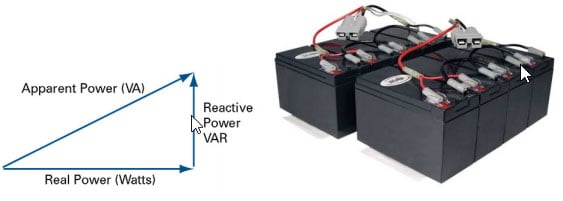
The typical power factor (CFP) of computer equipment ranges from 0.7 to 0.6; we are going to use the more conservative value 0.6; therefore the relationship between Watts and VA that matters to us is: (VA) x (CFP) =Watts
This means that a UPS marked 1000VA can power a source of 1000x0.6, that is, 600 Watts at most. In the same way, if you want to know the VA that your source needs; divide the power by 0.6; so that if your source is 1000W, then the UPS you need is at least 1000W/0.6 or 1666 VA at least.
As an example, let's take a 1750 VA UPS. Here you'll have to use a formula. It's not difficult, but it will give you an exceptionally useful piece of information. You'll use the following data:
All UPS' s must have at least one battery... be careful because we often buy voltage regulators instead of UPS.
Here we are practical and we get you the data you need:
B: Let's assume that your UPS has 1 battery. Of course there are units with more than one battery. Pay attention to this fact, in case you get your hands on a UPS with more than one battery.
V: You'll use 12 volts (generally all UPS batteries are 12V, but there are different types of batteries). You will need to validate this information with the manufacturer of your UPS).
Oh: We will take 9 Amperes Hours (you can validate it in the manufacturer's manual). For small UPS it can be 7, 9 or 12
Eph: UPSs have an average efficiency of 95%. You'll use 0.95 (NOTE: IT DEPENDS ON THE BRAND AND TECHNICAL DATA OF EACH UPS. I RECOMMEND THAT YOU REVIEW THIS INFORMATION IN YOUR COMPUTER'S MANUAL). The more efficient, the better the equipment you choose.
IT GOES: Remember that it's Volt-Amps from the UPS.
Conclusion
The formula for service time in blackout is: ((B x V x Ah x Ef)/VA) x 60= Minutes of service. In order to determine the amount of UPS for a data center, it will depend on the availability we want our data center to have, now in order to determine the capacity of the UPS, it is necessary to add up all the consumption in watts or VA of all the equipment to be backed up, and then multiplied by 30% as a growth factor, you must consider a minimum of 5 minutes to back up at full load to give your emergency silver time so that it can take care of all the load when the power supply arrives again.
Remember that a UPS is a transition device, which means that it will only give you a limited amount of energy so that you can perform other actions to help you continue to operate your data center.
Tip: The more backup time at full load you need, the more batteries you are going to take up, so your UPS solution may be more expensive than expected, so I recommend that you consider a backup power plant at the same time as your UPS.

