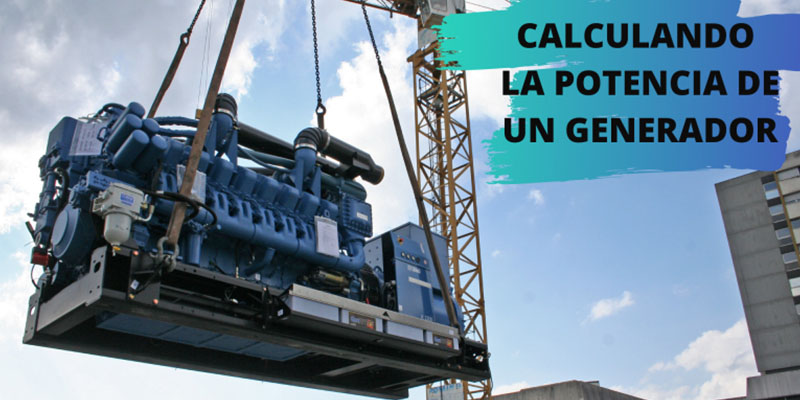

One of the keys to choosing the right generator you need for your project is power. A correct selection of the power of the electric generator will guarantee us efficient energy delivery, care for the useful life of the generator and correct fuel consumption.
First you have to answer yourself 3 basic questions to be able to calculate:
What are we going to connect to our generator set?
With regard to what we are going to connect, we will need to know the powers of all the devices, electrical tools, machines, equipment, etc. that are going to be connected simultaneously; since the group must generate us enough power to power them.
Maybe at times we can turn off some devices when connecting others and so it's not necessary for them to work all at once, this can be a Tip to greatly reduce the cost.
How do we need the devices to be connected?
How they are going to be connected is another very important variable, since in many devices or machines the consumption at start-up is much higher, a fact that implies that the necessary consumption can be very different depending on whether we need to start all the equipment simultaneously or, on the contrary, we can connect them sequentially
How often will the generator be used?
If the electricity generator will be used only in cases of emergency, we can adjust the power quite a bit because it doesn't matter if the group works occasionally within the emergency power range.
On the contrary, in situations where the generator will be the main source of energy, it must be calculated between 10% and 35% more power, in order for the generator to work within the continuous power environment.
Basic definitions for calculating the power of the current generator:
A one horsepower motor is equivalent to a 736W motor.
Calculation of the constant power...
Now we are going to proceed to calculate the necessary constant power of the generator set, referring to the constant power consumed without taking into account the starting peaks, that is, with the devices or equipment already in operation. The most recommended thing is to make a table or list with the consumption of all the devices that we are going to have to connect, and add up the power of all those that we are going to have to connect simultaneously.
Taking into account the type of start...
The power consumption at start-up can be between 2 and 5 times greater than the constant consumption when started, depending on the type of engine start.
Here we must know what type of start each device has (light, medium or heavy) in order to calculate the power consumed when starting each device and thus ensure that the group will be able to start them.
From here on, we can calculate the required power of our current generator...
Once we have the starting powers and the constant powers, we will calculate the total power needed according to the devices that we must connect simultaneously or sequentially and the way in which we are going to connect them. The most critical situation will always be in the starting peaks.
From here we will obtain an active power value in kW, which once the power factor has been applied as indicated in the basic definitions, will result in the real or apparent power (kVA) that our generator set will need. Generators are universally identified by their power in kVA.
kVA = kW/f.d.p —> kVA = kW/0.8
It is ALWAYS advisable to apply a safety margin...
We must say that to the necessary power of the generator set that has resulted in us, it is always advisable to apply an increase as a safety margin (10-20%), since this is how:
Once the safety margin has been applied, we already have the approximate power that the generator set we are going to buy should have.

